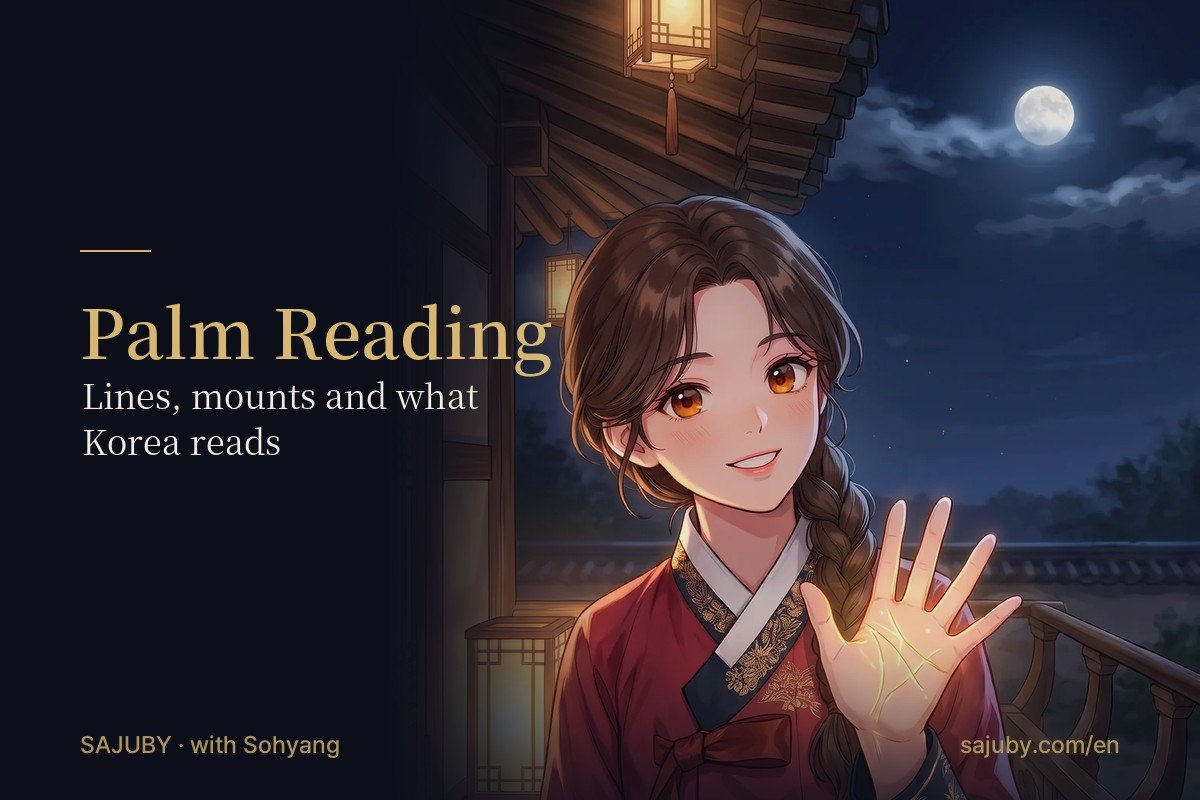
Sonkkeum (손금) is Korean palm reading. It borrows the line names from the wider East Asian and Western traditions and reads them alongside the shape of the hand and the fullness of the mounts. Koreans tend to treat it as lighter than saju, a thing friends do to each other, but a structured reading covers more than most people expect. Here is the framework.
Which hand
Traditionally the left hand shows what you were born with and the right hand what you have made of it (for right-handed people; reversed for left-handed). Most readers read both and weigh the dominant hand for the present.
The three main lines
- Life line (생명선). Curves around the thumb. Read for vitality, constitution and major life changes, not length of life. Breaks and branches mark turning points.
- Head line (두뇌선). Runs across the middle of the palm. Read for how you think: straight and long for analytical, curved and sloping for imaginative, short for practical and decisive.
- Heart line (감정선). The upper horizontal line. Read for how you love: ending under the index finger for idealistic, under the middle finger for practical, a deep curve for expressive, a straight line for reserved.
Secondary lines
- Fate line (운명선). Vertical from the wrist toward the middle finger. Career direction and whether it was chosen or handed to you. Not everyone has one; its absence is read as a self-directed life.
- Sun line (태양선). Toward the ring finger. Recognition, reputation, creative success.
- Marriage lines (결혼선). Short horizontals on the edge of the palm below the little finger. Significant relationships, not a count of marriages.
- Money lines and the “M.” Folk favourites: a clear M formed by the main lines is read as good fortune; fine vertical lines under the little finger as financial sense.
Mounts and hand shape
The fleshy pads at the base of each finger and thumb are the mounts, each tied to a quality: the thumb mount (Venus) for warmth and vitality, the index (Jupiter) for ambition, the middle (Saturn) for seriousness, the ring (Apollo) for creativity, the little finger (Mercury) for communication and business. Full, firm mounts are read as strong in that quality. Hand shape (square, long, mixed) sets the overall temperament.
How a photo reading works
A clear photo of each palm in daylight, fingers slightly spread, camera straight above, is enough to read the main and secondary lines and the mounts. It cannot assess skin texture or firmness, which matter for some traditional readings. Sohyang’s Palm Reading on SAJUBY works from palm photos, follows this line-and-mount framework, and delivers a written PDF report.
Lines change
Unlike a saju chart, palm lines shift over years. Readers in Korea suggest a new reading every few years, and comparing old and new photos is genuinely interesting: fate lines appear, marriage lines deepen, head lines lengthen in people who took up study late.