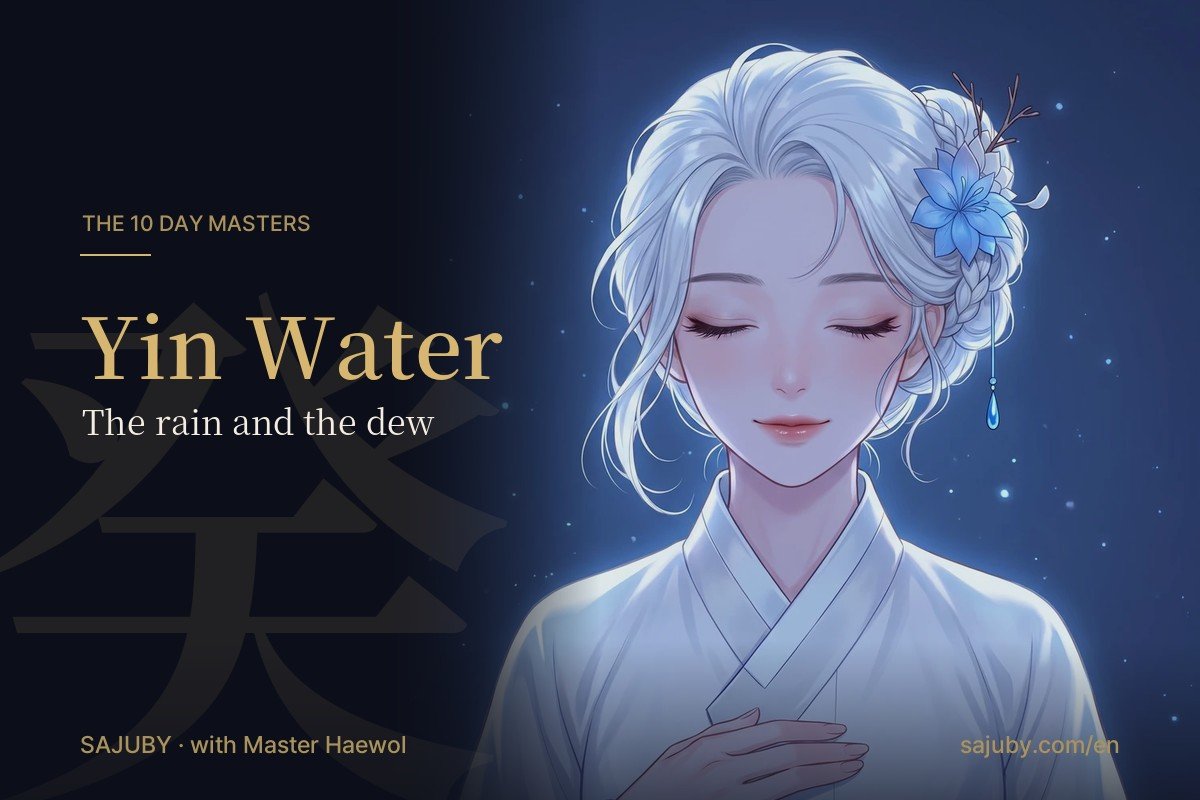
Why do yin water people often know what you feel before you say it? In saju 癸 is rain, mist and dew: the gentlest stem in the chart, and the one that seeps into everything.
Your day master (일간, ilgan) is the heavenly stem of your birth day, the character that stands for you in a saju chart. Yin Water (癸, 계수) is the rain and the dew. The classical text Jeokcheonsu (滴天髓) opens its verse on this stem with 癸水至弱: “Yin water is the gentlest of all.”
What is a yin water day master like?
Yin water is intuitive, perceptive and quietly persistent. Readers describe a gentle, imaginative person who reads people and situations well. The classical verse calls 癸 “the weakest of all” and then says it reaches the heavens: rain is soft, but it wears down stone. Yin water is adaptable and private, often more resilient than it looks, and it can retreat into itself when the environment feels harsh.
What are the strengths and weak spots of yin water?
Strengths
- Intuition and empathy
- Imagination and depth of thought
- Quiet persistence
- Adaptability
Watch for
- Anxiety and overthinking
- Withdrawing instead of speaking up
- Absorbing other people’s moods
- Indecision when options multiply
What work suits a yin water day master?
Yin water suits work that uses insight: psychology, counselling, writing, research, design, planning, healthcare, spiritual and advisory work. It is drained by loud, aggressive environments. For the other nine day masters side by side, see career fit by day master.
How does yin water love?
Yin water feels deeply and needs safety to show it. It is attentive and gentle, and it remembers. It does poorly with harsh conflict. Partners who are patient and consistent find it one of the most devoted day masters.
In the stem tables 癸 combines with 戊 (Yang Earth), one of the five classic stem pairings. A partner whose day master is 戊 is traditionally read as a natural pull, though the rest of both charts decides whether the pull is comfortable.
How do the other elements read for a yin water day master?
In saju every other element in your chart is named by its relationship to you, the ten gods (십신). For yin water the map looks like this:
| Element | Is your… | Stands for |
|---|---|---|
| Water | Companions (비겁) | peers, siblings, rivals, independence |
| Wood | Output (식상) | expression, skill, children, creativity |
| Fire | Wealth (재성) | money, resources, and for men traditionally a partner |
| Earth | Officer (관성) | authority, structure, reputation, and for women traditionally a partner |
| Metal | Resource (인성) | learning, support, mothers and mentors, rest |
Why can two yin water people be so different?
Because the day master is one character out of eight. A yin water born in a season of its own element is “strong” and does best when it spends energy; one born in a season that drains it is “weak” and does best with allies and structure. The month of birth, the other pillars and the ten-year luck cycle all change the advice. Compare with its sibling, Yang Water (壬), or start from what a day master is.
Master Haewol reads your day master with its strength, season and luck cycles in her Classical Saju reading; you see your chart before you pay.
Back to all 10 day masters